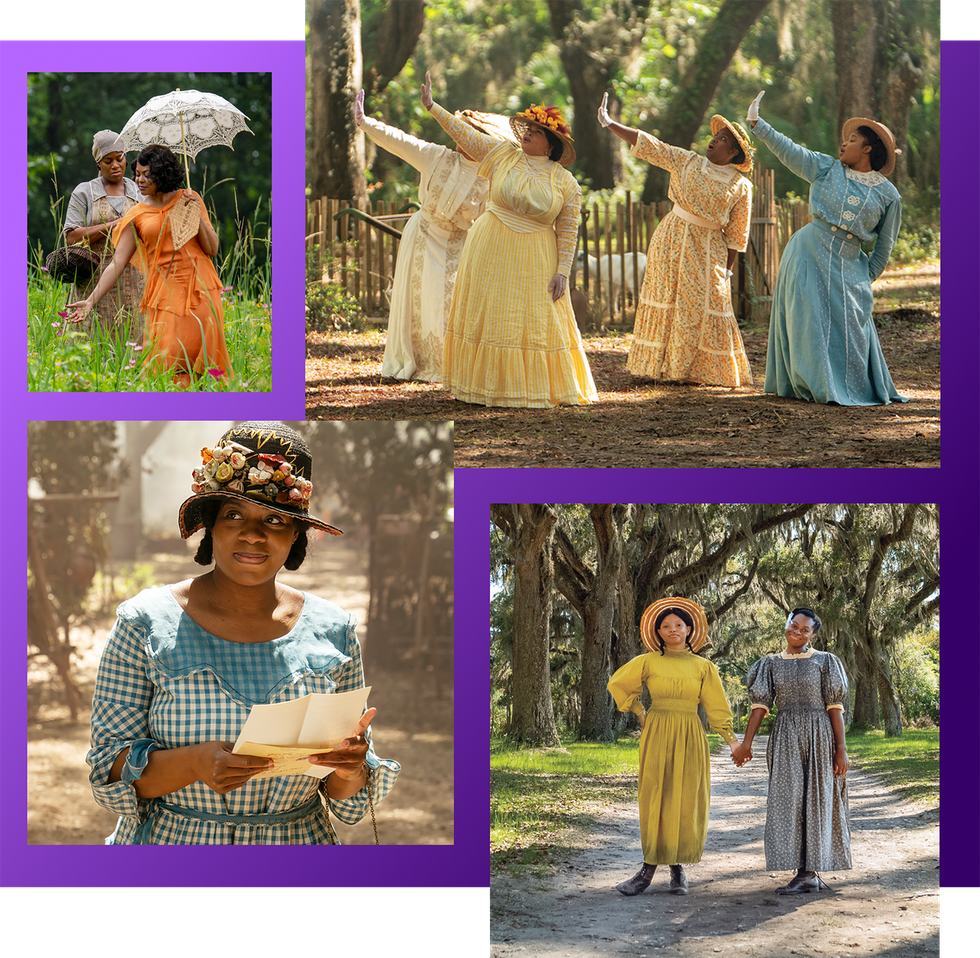
(Spoilers ahead.)

Yesterday, Boxing Day, I saw the new “The Color Purple” movie with my mom and sister. I wept through the second half, clinging to my sister’s hand.
Reading The Color Purple in Feminist Theology during college changed my life. It caused me to question everything I thought I believed about God. More about my feminist awakening here.
I’ve read the book several times, and I soaked up the 1985 movie, even though it skipped over some important themes (like Celie and Shug’s affair). I cried through the scenes of Celia and Nettie’s separation and eventual reuniting. When I adopted my first cat, I named her “Shug.” We’ve stayed in the Alice Walker room at the Sylvia Beach Hotel.
So when I saw the new movie trailer, I had to see it as soon as possible, ideally with my sister.
The movie is glorious–gorgeous singing, transcendent acting, and such joy in the midst of difficult times and themes. This movie is different in many ways from the 1985 version, especially because it was directed and adapted/written by Black people.
Doing research about the actors, I discovered several inspiring stories. Fantasia Barrino (who plays Celie) dropped out of school after she was raped. Danielle Brooks (who plays Sofia) describes her experience of seeing “The Color Purple” on stage at age 15 and it giving her confidence to pursue her craft. Oprah Winfrey was feeling demoralized about her weight struggles when she got a call from Stephen Spielberg, offering her the role of Sofia and telling her to stop worrying about losing weight. In a similar way, the new movie’s director, Blitz Bazawule, convinced Taraji P. Henson she could embody the sultry Shug Avery…and her voice and persona were strong enough to rock the role.
“The Color Purple” is a story of strength, loss, resilience, and redemption. It’s about sisterhood, and women saving themselves with the support of their sisters.
The brilliant actor/singers carrying this film are speaking out about pay inequity in Hollywood, especially for Black women.
“I’m only human and it seems that every time I break another glass ceiling, when it’s time to renegotiate I’m at the bottom again like I never did what I just did and I’m tired,” –Taraji P. Henson, who plays Shug
Although I LOVED the movie, I still have two bones to pick with it:
- Skimping out on the love story: It’s a beautiful love story between two women, and the 2023 version still waters down that romance so you could actually miss it if you were not looking for it. Read the book. When will we have a film that honors the healing love between Celie and Shug?
- Missing God ain’t a he or she but it: The book is written in letters…first Celie is writing to God, who she sees as a white man in the sky. Then Shug helps her realize God is not a white man in the sky…God is not a he or she, but an it. Celie then starts writing her letters to Nettie instead of God. Both movies and the Broadway play mention God, but they don’t reference the nonbinary nature of God…which was one of the most important aspects of the story for me.
“God ain’t a he or a she, but a it. God don’t look like anything . . It ain’t somethin’ you can look at apart from anythin’ else, includin’ yourself. I believe God is everything … everything that is or ever was or ever will be. And when you feel that, and be happy to feel that, you’ve found it.
My first step from the old white man (as God) was trees, then air, then birds, then other people. But one day when I was sitting quiet and feeling like a motherless child, which I was, it came to me: that feeling of being a part of everything, not separate at all. I knew that if I cut a tree, my arm would bleed. And I laughed and I cried and I run all around the house. In fact, when it happen, you can’t miss it. It sort of like, you know what,” she say, rubbing my thigh high up.
Shug!-I say. Oh, she say, God love all them feelings. That’s some of the best stuff God did … Listen, God love everything you love -and a mess of stuff you don’t. But more than anythin’ else, God love admiration.
You sayin’ God vain? I ast. Nah, she say, Not vain, just wantin’ to share a good thing. If you walk by the color purple in a field somewhere and don’t notice it, I think it pisses God off.“
If you view any cast interviews, you’ll see the magic among these powerful Black women and how this story has affected them. Go see the movie, and read the book!

 Every Day Is a Miracle